Showing posts with label koshihikari. Show all posts

Friday, December 12, 2014

Rice Harvesting - Guest Post by Pelle Blomster


Rice plays a major role in these parts and many of the autumn festivals coincide with the rice harvest. Over in Nakazato you can experience rice harvesting by hand and some friends of our went along to see what it was like. Here is the report from Pelle and Emilia.

Rice harvesting in Echigo-Nakazato.

Each season brings different experiences in the Snow Country. Winter brings abundant snowfall excellent for all kinds of winter sports. Spring is beautiful with its cherry blossoms and wild rivers. In summer there are many festivals and the lush mountainous nature to explore. Autumn is great for trekking among the changing colors of the trees. Autumn is also the time for harvesting the famous Niigata Koshihikari rice.


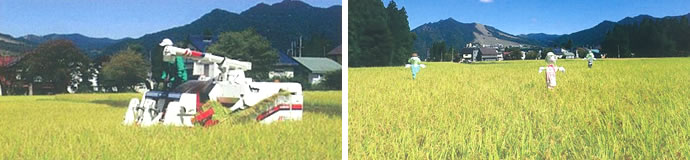
Through Hop Step Japan we had the opportunity to try traditional rice harvesting on our latest trip to Snow Country. On a beautiful, sunny autumn day we hopped on our bikes and set out for Nakazato and the rice harvesting experience. We were excited to try harvesting one of the culinary gems of Niigata, Koshihikari rice, but also a bit nervous due to our lack of Japanese language skills. As I turns out it was a wonderful day, and the helpful staff made sure we knew what to do by giving a demonstration. So with about 100 other eager participants we soon got to work cutting down a whole field of rice. People of all ages made an effort together, and little kids enthusiastically carried around bundles of rice bigger than themselves. The only time work was halted was when a frog was found in the rice field. After a while and many pictures everybody got back to work. The kids got to take turns riding the harvesting machine and looked very happy. It was amazing how quickly you can harvest a rice field by hand when working together side by side.


It was a fun way to feel a connection to the community and the area, were rice fields stretch out as far as the eye can see. After harvesting we all posed for photographs and were rewarded with one kg of premium koshihikari rice and a bathing ticket to try a local onsen. The friendly organizers reminded us to stop by the harvest festival held near the Nakazato station the next day, and we promised to do so.


After the harvesting we rode our bikes to the trendy 3-ji café in front of the Nakazato station for lunch, and had some delicious curry with homegrown vegetables. We highly recommend trying out the local specialities of the snow country area for a taste of the real, friendly, rural Japan.


Friday, May 18, 2012

Cross10 Tokamachi

Cross 10 is a road station just off the main street of Tokamachi. It has just had a refit and is now a great place to have a break or do a bit of shopping. It is right next to Kinare so there is plenty in the area to do if you have a bit of extra time.


There are a few different shops but they all celebrate the best of the area with local sakes, foods, materials and crafts. There are some really interesting souvenirs and you can be safe in the knowledge that they are all made by local craftsmen. The kimono heritage of the area is also prominent with material, accessories and kimonos for sale at a couple of specialist boutiques. Business card cases made out of kimono material are an example of one of the unusual items on sale.


 There is also a record-breaking display of hand-made decorations hanging from the ceiling as well as photographs and information about local events and attractions.

It is worth planning to eat there as there is a fantastic restaurant that specialises in local produce - seasonal and freshly harvested, prepared simply to showcase the fantastic flavors. It is also great value and is a modern take at Japanese fast food where organic local ingredients are the star of the show. Manma and cafe Yukimatsuri is the name of the establishment and it is highly recommended if you would like to savor the taste of Snow Country.


Wednesday, October 12, 2011

Yuzawa Harvest Festival - October 16

It is still harvest time in Snow Country and the harvest festivals continue. They are a time honored tradition in rural Japan and a great chance for the local population to get together and enjoy the bounty of the land. Snow Country produces lots of great crops, the most famous being the Koshihikari rice and on Sunday October 16th it is Yuzawa's turn to celebrate with their matsuri in the Chuo Park.


It is a great day out and even made it onto a current affairs program last year. There is lots to eat and drink, and you will get a real taste of the terroir of the area. Rice features in many of its forms - rice balls, mochi and sake to name but a few - and other local delicacies will be on offer.


The park itself is a beautiful location and sure to be full of families out to enjoy the activities, games and stalls gathered there for the Harvest Festival.

Sunday, October 2, 2011

New Rice Season

It is officially harvest time and the new season rice is out there to be enjoyed. Snow Country is proud to produce such high quality rice and visitors to the region are always keen to see what the fuss is about. Try it and you will see.


There is a campaign running at the moment to let people try some traditionally cooked Koshihikari rice fresh from the harvest. Lots of shops and accommodations are participating so if you are in Snow Country, pick up a leaflet with a map and head along to your favorite location to try the rice. You won't be disappointed.

If you see one of these contraptions you know there is likely to be delicious rice underneath and you will probably be able to pick up the scent as you approach.

There is a prize draw you can enter as part of this campaign and if you are lucky enough to win, you could be heading home with a 2 kg bag of Koshihikari.


Thursday, September 29, 2011

Rice Plant Art 2011 - October 10th

Rice is probably the most famous export of Snow Country but not content to just grow it, it also becomes a medium for creative expression. Using several different varieties of rice plant, and without the use of any pesticides or fertilizers this picture has been created in a local rice field. The theme for this year's creation was "Daruma" - the lucky doll that is traditionally used for encouragement.


The field is due to be harvested by hand on October 10th and people are welcome to join the fun (meeting in Echigo Yuzawa Station from 10.30 to 11.) The rice is due to be donated to the victims of the earthquake and tsunami in March in Fukushima.

Saturday, September 24, 2011

Hakkai San Autumn Colors and Seasonal Produce

This is a beautiful season to visit Snow Country. The surrounding mountains are covered in different types of trees and the changing of the colors in this area is stunning, with each variety having different hues at different times. Down on the valley floor the rice is ready to harvest and the delicious new rice and other produce is a source of local pride. The are lots of great ways to see the autumn colors and one of the best is to hop on one of the bus tours.


A great option is the autumn tour leaving from Muikamachi Station, running from October 8th to November 6th. It drives along the scenic Skyline road which has stunning view down the valley and across the local peaks. It then arrives at Hakkai San Ropeway which will whisk you up to the lookout for more great views and a close up of the autumn colors. They are also offering freshly prepared rice balls from newly harvested koshihikari rice and the famous local mushroom soup. Once back down, there is a stop at the Tomioka White Museum for some more stylized landscapes before heading back to the station.


This tour has a bit of everything to let you capture the very essence of Snow Country - local produce, natural beauty and unique culture.

Thursday, September 8, 2011

Koshihikari Harvest

The first newly harvested rice of the season in now in the shops though the harvest has yet to start in earnest in Snow Country. The rice harvest is a sure sign of autumn and the changing of the seasons that play such an important part in Japanese life.


The temperatures start to drop (although there should be plenty of fine days ahead) and the preparation for the long cold winter begins - the nights here are already starting to feel colder. After the heat and humidity of the summer, the cooler days of autumn are a welcome change for most. The hikers especially make the most of this season and nature obliges with a fantastic show of autumnal colours. Most areas of Snow Country put on an amazing display of the changing of the colours as the surrounding mountains are all covered in trees and the variety of species means a broad range of colours. The colours won't be at their best for a few weeks but looking up into the mountains you can already see them starting to turn and they are well worth a trip to come and see. Some of the more famous areas are the Hakkaisan Ropeway, the boat trip on Okutadami Lake, the Tanigawadake Ropeway and the Dragondola at Naeba. All of these offer amazing views with the minimum of effort. Those more physically inclined are spoiled for choice as every area of Snow Country offers stunning scenery.

Thursday, August 25, 2011

Koshihikari Rice

Snow Country has a proud gourmet tradition and central to this is the rice production of the region. As we approach the end of summer we are getting close to rice harvesting season, and everywhere you look, the rice fields are covered in green. A common image used is the the green sea: gusts of wind move the mature rice plants as if waves are passing through them. The four seasons are an important part of life in Japan and it is a beautiful time to visit Snow Country.


The Koshihikari strain of rice is grown in many parts of Japan but the rice grown around Uonuma is highly prized and frequently commands the highest price in Japan. One of the main reasons for this is the  due to the snow. As the snow melts in spring, all that crisp, pure water floods the rice field and helps produce such a tasty end product. The frequent rains of early summer and hot, humid temperatures afterwards provide ideal growing conditions.

Rice has always been an important crop in this area. It stores well over the snowbound winter and is also the base for many of the important products of the area such as sake, rice crackers and the different mochi sweets. The stalks of the rice plant are used to make tatami and in times past were also used to manufacture over garments, headwear and footwear for use in the snowy months. It is easy to see why it is highly revered in these parts.

The rice farmers work hard all summer and autumn but the snow buries their workplace for half the year (something many modern workers should pray for) forcing them to pursue other lines of work. If you find yourself in Snow Country for winter there is a good chance that your minshuku owner, lift operator or ski instructor has had a hand in producing that delicious bowl of steaming koshihikari rice you tuck into a lunch time. The deep, leathery tan is normally a good indicator.